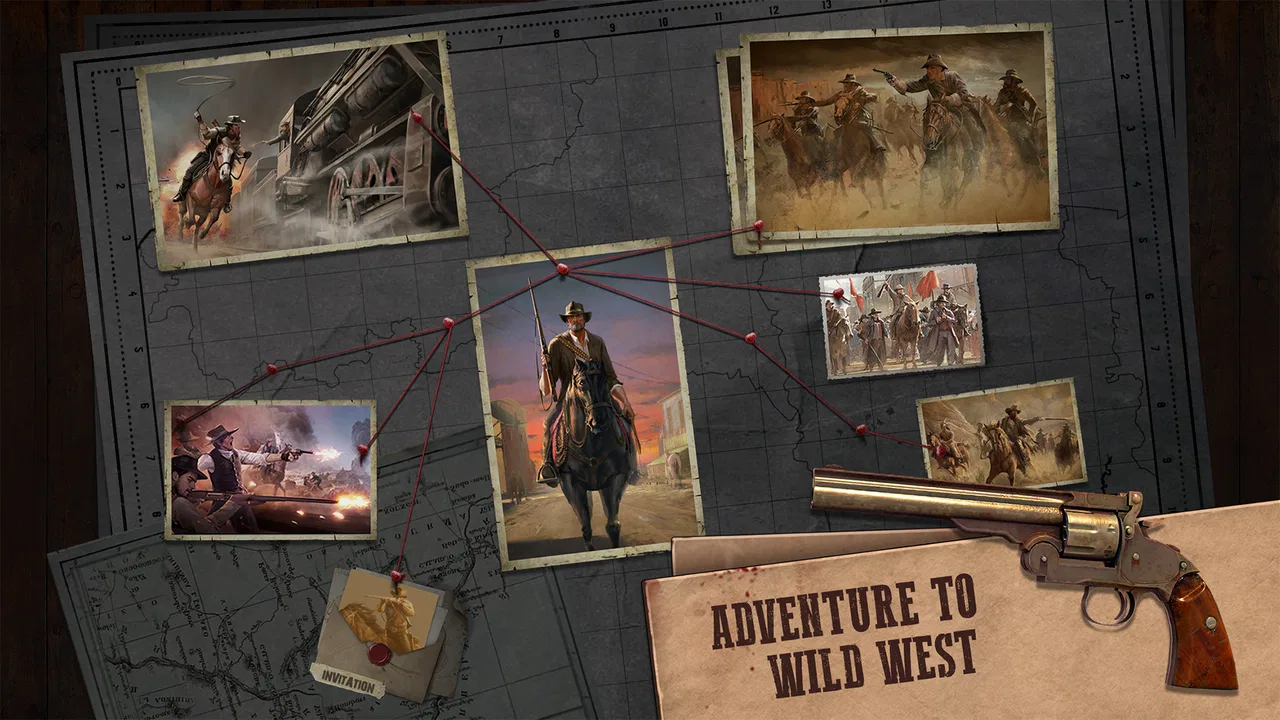
West Game
- 4.3
- Rating
- 10.00M
- Installs
- Free
- Price

 Analysis by App-foxy
I spent time with West Game as a strategy game built around the Old West, and the part that stayed with me was not simply the cowboy setting. Its real appeal is the way it turns gradual settlement management into a series of decisions about timing, priorities, and patience. You are not just tapping through a western story; you are trying to make a growing frontier base work while several demands compete for your attention.
That focus makes it easier to understand who will enjoy the game. If you like checking a plan, starting several improvements, and returning later to see how your settlement has changed, this has a comfortable rhythm. If you want a quick action game with constant direct control, it may feel slow. I would describe it as a mobile strategy game for people who enjoy progress that accumulates over time rather than arriving in one dramatic burst.
LeyiGames has kept the presentation centered on the Old West theme, and that gives the familiar settlement formula a more distinctive personality. The free download makes it easy to try, although optional purchases range from $0.99 to $199.99 per item. I would approach it as a game that can be sampled without paying, while remembering that the purchase scale can become significant for players who want to speed up progress.
You May Also Like

 Pandora - Music & Podcasts
Pandora’s Music Is Easy to Start, but Harder to Recover
Pandora’s strength is its low-effort path from a seed to a station. Its weak spot is how much confidence it asks you to place in connection, setup, and quiet recovery.

 AccuWeather: Weather Radar
AccuWeather Review: A Quick, Clear Forecast for Everyday Decisions
For everyday plans, the best forecast is the one you can understand quickly. AccuWeather makes rain timing, radar, and local conditions easy to act on, with a few trade-offs.

 Hill Climb Racing
Why Hill Climb Racing Still Turns Crashes Into One More Run
A tiny car, a bumpy hill and one more upgrade: Hill Climb Racing keeps resurfacing because its simple chaos makes every near-miss feel personal.

 AliExpress - Shopping App
AliExpress Makes Global Shopping Feel Personal, but Shoppers Bear the Risk
AliExpress turns a global marketplace into a pocket-sized discovery engine. Its reach is useful, its shopping loop compelling, and its trade-offs easy to miss.

 Lords Mobile: Kingdom Wars
Lords Mobile Is a Kingdom-Building Routine, Not a Quick Match
A case-by-case verdict on the building, battles, device demands, and social commitments that make Lords Mobile rewarding for some players and exhausting for others.

 PDF Scanner app - TapScanner
TapScanner Makes Paperwork Easier to Capture, Check, and Share
TapScanner makes scanning with a phone feel less like a rescue operation and more like a dependable step in getting work done. Its capture tools are useful, though not flawless.
More From Our News Desk
View All News


Why the settlement-building loop matters
I find the settlement-building loop matters because it gives each visit a practical purpose: I can decide what to improve now, what to save for, and what to leave running while I’m away. That makes the game’s gradual pace easier to judge than a string of isolated upgrades. The next question is whether the game makes those choices feel like visible progress.
The key capability is turning time into strategic progress
The most important capability here is the ability to organize a frontier settlement around several parallel goals. Instead of treating every action as an isolated task, I found myself thinking in chains: improve one part of the town, prepare the next requirement, spend available resources carefully, and return when an ongoing task is ready. That is where the strategy lives.
This approach works because the game gives ordinary waiting a purpose. A construction or improvement is not merely a timer placed between you and the next screen. It encourages you to decide what deserves attention first. Should you strengthen the part of the settlement that supports future growth, save resources for a more important upgrade, or use the current session to prepare several smaller steps? The Old West backdrop makes those choices feel like frontier planning rather than abstract menu management.
I especially liked that the game rewards players who think one or two steps ahead. A short session can be useful if I begin a sensible improvement before putting the phone away. When I return, I have something new to inspect and another decision to make. That makes it suitable for people who prefer a game that fits around a day instead of demanding a long uninterrupted sitting.
There is also a psychological strength in seeing a settlement develop gradually. A single upgrade may not feel dramatic, but several well-timed decisions create a noticeable sense of ownership. I began to recognize which parts of my routine were helping progress and which were simply consuming resources without a clear purpose. That kind of feedback is more valuable than a crowded screen full of buttons.
How the system feels during a normal play session
My usual session started with a quick review of anything that had completed, followed by a check of available resources and the next useful improvement. I then chose one main objective rather than touching every option at random. That small habit made the game feel much more manageable. New players can easily lose direction when several activities appear available, so I recommend deciding what you want from the session before spending anything.
A practical routine is to separate immediate actions from long-term ones. Immediate actions are the tasks that can be completed or prepared during the current visit. Long-term actions are the upgrades that require more planning or a larger resource reserve. Keeping those categories apart helped me avoid the common mistake of using everything as soon as it appeared. In this game, having a reserve is often more useful than enjoying a brief burst of activity.
The interface is at its best when it lets me see progress without demanding constant attention. I could make a few decisions, leave, and come back with a clear reason to continue. That is a better fit for a phone than a strategy game that expects the player to remain active for an hour. Still, the rhythm depends on accepting that not every visit will produce a major breakthrough.
For someone new to this style of game, my strongest advice is to avoid treating every highlighted option as equally urgent. The western theme may make the settlement feel lively, but the underlying decisions are economical. Before committing resources, I would ask what the action unlocks, whether it supports the next goal, and whether spending now will leave the settlement unable to handle a more useful improvement later.
A realistic everyday use case
Imagine having ten minutes before leaving for work or school. I would open the game, collect anything ready, review the settlement, and set one improvement that can continue while I am away. I might then use the remaining time to prepare resources or inspect the next requirement rather than starting a string of unrelated actions. That gives the session a clear beginning and end, which is important because open-ended mobile strategy games can otherwise absorb more time than expected.
Later, during a lunch break, I could check the result, make a second decision, and leave again. The game works well in that pattern because progress is not tied entirely to constant manual input. The trade-off is that the experience can feel less satisfying if I only want a complete game in a single sitting. West Game is designed around returning to an evolving settlement, not finishing a full strategic arc in one visit.
This routine also shows why planning matters more than speed. A player who opens the game repeatedly but spends resources without a goal may progress less efficiently than someone who checks in less often and makes more deliberate choices. I found that the best sessions were not necessarily the longest ones. They were the sessions where I knew what I was trying to accomplish before touching the next button.
The Old West setting changes the feel of familiar strategy
Many mobile strategy games use fantasy kingdoms, modern armies, or futuristic colonies. West Game takes the same broad appeal of building and managing a growing base and places it in a frontier setting. That does not remove the need for planning, but it gives the decisions a warmer identity. A settlement in the Old West feels more personal to me than an anonymous collection of production screens.
The setting is also useful for players who have grown tired of medieval castles or science-fiction interfaces. It is not enough by itself to carry a strategy game, but here it gives the management loop a clear visual and thematic frame. I found it easier to stay interested in gradual development when the game presented that progress as the growth of a western town.
Compared with a traditional single-player strategy title, the experience is more about ongoing mobile progress than about completing a carefully bounded campaign. Compared with a fast competitive game, it asks for more patience and less reflex. That middle ground is its strongest position: it offers planning without the complexity of a desktop strategy game and progression without requiring every session to be intense.
Where the experience creates friction
The biggest limitation is the pace. Players who dislike timers, repeated check-ins, or gradual upgrades may find the central loop repetitive. I could appreciate the value of planning and still recognize that the game sometimes asks me to wait for the next meaningful step. That is not a flaw for everyone, but it is a decisive preference.
The free-to-play structure also deserves a realistic warning. Because individual purchases can reach $199.99, I would not recommend entering without a personal spending limit. The game is easier to enjoy when purchases are treated as optional rather than as the expected way to maintain momentum. Anyone who feels pressure to buy whenever progress slows should be especially careful.
Another trade-off is attention. The game fits short sessions, but its design encourages a return habit. That can be convenient when I want a small strategic break, yet distracting when I am trying to keep my phone use under control. I recommend turning the experience into a planned routine instead of checking automatically throughout the day.
The Teen content rating is another reason to think about the intended audience. It is not a game I would choose for a young child simply because the western art style looks approachable. Parents should consider the age guidance and the presence of in-app purchases before allowing unsupervised play.
Tips that made my progress feel more controlled
My first useful adjustment was to choose a settlement priority for each play period. One session might focus on development, while another might focus on preparing resources. This prevented me from scattering effort across too many small actions. The game became clearer once I stopped trying to advance everything at once.
Second, I learned to treat completed tasks as a planning opportunity rather than an invitation to spend immediately. Collecting a reward feels satisfying, but the better question is what it enables. Holding resources briefly can make the next important improvement possible, especially when several attractive options compete for the same pool.
Third, I found it helpful to start longer tasks before a predictable period away from the phone. That could be a work block, a commute, or sleep. The point is not to optimize every minute; it is to make waiting work in the background. Starting a long process just before a short break is less useful than matching it to the time when I know I will not be playing.
Finally, I would avoid judging the game by its first few sessions alone. The early loop teaches priorities, but the real test is whether I enjoy returning to a settlement that changes incrementally. If the idea of gradual improvement already sounds tedious, more time will probably not change that reaction. If it sounds satisfying, the slow rhythm becomes part of the appeal.
Who will get the most from this game
West Game is a good match for players who enjoy Old West strategy, resource decisions, and a settlement that develops over repeated visits. It suits people who like having a clear project waiting for them on a phone, especially when they prefer thoughtful progress to rapid combat. The current version is 7.3.3, and it runs on devices using Android 6.0 or later, which makes it accessible to owners of many older Android phones as well as newer models.
The game has built a substantial audience, with over ten million installs, a 4.3 average from around 207 thousand ratings, and roughly 27 thousand written reviews. Those figures suggest that the format has broad appeal, but they do not remove the personal question of whether its pace suits you. I would use them as a sign that the game is established, not as a reason to ignore its slower structure.
I would recommend it to a friend who enjoys checking a plan in the morning, making a few careful choices, and seeing the result later. I would not recommend it to someone seeking a self-contained strategy campaign, a purely skill-based challenge, or a game with no temptation to spend. In those cases, a premium strategy title or a more direct action game would probably be a better fit.
My final recommendation
After playing it, I see West Game as a patient management game dressed in a recognizable western world. Its best feature is the way it turns small decisions into a continuing settlement plan. When I played with a goal, saved resources for meaningful steps, and matched longer tasks to time away from the phone, the loop felt rewarding and easy to fit into daily life.
Its weaknesses are closely connected to that strength. Progress can feel slow, returning can become habitual, and the wide in-app purchase range means I would set boundaries before playing seriously. Those are not minor details; they determine whether the game feels relaxing or demanding.
For me, the deciding question is simple: do you enjoy watching a frontier settlement grow through deliberate choices? If yes, this free strategy game is worth trying. If you need constant action or dislike waiting, I would skip it. Its strongest reward comes from planning the next step, not rushing through the current one.
Developer: LeyiGames. The game is free to download and carries a Teen age rating. I would start without spending, learn the settlement rhythm, and only then decide whether the optional purchases add enough convenience for my own style of play.
FAQs for West Game
01What is West Game about?
West Game is a Wild West strategy game in which you build and manage a frontier town, recruit cowboys, upgrade facilities, gather resources, and compete against other players. You can expand your territory, form or join an alliance, complete missions, and take part in battles. Progress depends on planning, resource management, and how effectively you develop your settlement and army.
02Can West Game be played offline?
West Game is primarily an online multiplayer experience and requires an active internet connection for most of its important features. Your town, account progress, events, alliances, and battles are connected to the game servers. Although some menus or previously loaded content may open briefly without a connection, you should not expect full gameplay offline. A stable connection is recommended to avoid synchronization problems.
03Is West Game free to download and play?
West Game can generally be downloaded and played for free, but it includes optional in-app purchases. These purchases may provide premium currency, speed-ups, resources, or other advantages that can reduce waiting times. You can make progress without spending money, although development may take longer and competitive events can feel more demanding. Parents should also review purchase settings before allowing children to play.
04Does West Game include multiplayer battles and alliances?
Yes, multiplayer interaction is a major part of West Game. Players can join alliances, communicate with other members, help one another, and participate in cooperative activities or large-scale conflicts. Battles may involve attacking enemy settlements, defending your own town, or competing in special events. Choosing reliable allies and coordinating upgrades, troops, and timing is important for long-term success.
05What devices are compatible with West Game, and is progress saved?
West Game is designed for supported Android and iOS smartphones and tablets, although exact compatibility depends on your operating system version and device hardware. A reasonably modern device with available storage should provide a smoother experience. Because the game uses online accounts and server-based data, progress can usually be restored when you connect the same account, but linking or signing in properly is recommended before changing devices.
Pros
- Deep city-building and resource-management systems
- Regular events provide fresh goals and rewards
- Strong alliance features encourage teamwork
- Western theme gives the game a distinctive atmosphere
- Playable on mobile devices with convenient progress syncing
Cons
- Progress can become slow without frequent resource collection
- Many upgrades require long waiting times
- Competitive events may favor players who spend money
- The interface can feel crowded for new players
- Requires a stable internet connection to play

West Game
Gallery